
How to Design a Garage-Flex Live-Space in Vermont
Garage Hobby Barn Design Guide: Overview
Our clients often come to us as part of larger project, or a standalone one, needing our help to design a new hobby barn garage for them. Whether to support your existing home, or new one, in a rural, suburban, or urban setting, this can be an exciting and rewarding project! To ensure a good outcome though, you may consider following the design and planning best practices we find that help our clients take their hobby garage and barn ideas to the next level.
Best Practices in Planning
Those include taking steps to determine space usage requirements, assessing existing building and site infrastructure and permitting needs. It’s also critical to consider aging in place, accessibility and universal design principles for forward adaptability to changing lifestyles and life chapters. With a frequently unstable climate and global warming it is critical to meet or exceed energy efficiency standards, and improve your home’s resiliency to climate shocks and spikes in energy prices. This easy-to-understand guide will walk you through some of the important planning and design steps we follow.

Modern Farmhouse Barn: Garage, storage, bike/ski shop, and entertainment area, St. Johnsbury, VT area.
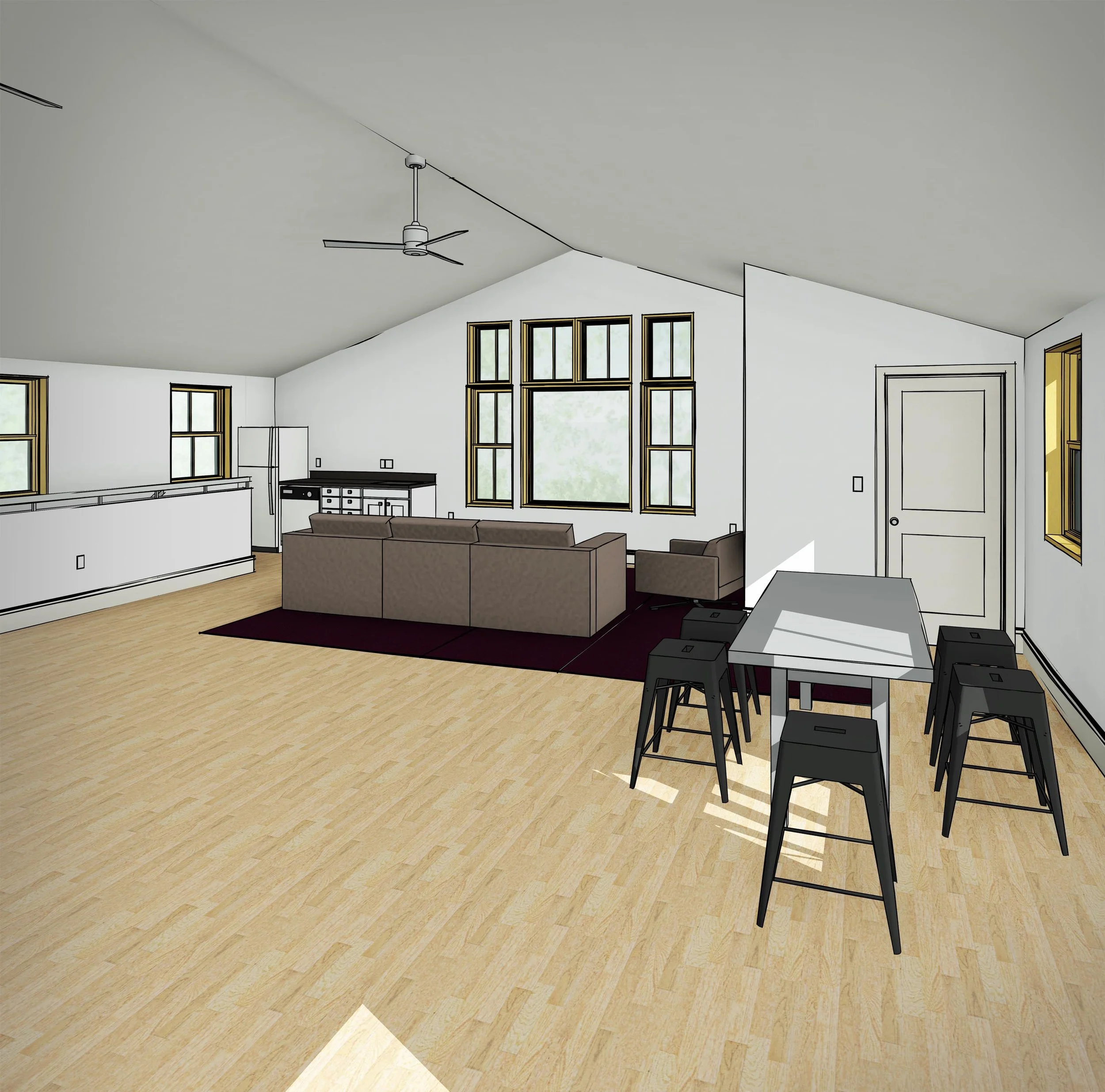
Modern Farmhouse Barn - Interior 2nd floor view of living and entertainment area
Step 1: Determine Primary Uses and Functions:
Identify the different types of space required for your garage hobby barn live space. Consider the needs for vehicle storage, floor to ceiling heights, seasonal home storage needs, miscellaneous equipment, workshop areas, mechanical room, flexible sleeping and living unit space. Calculate the approximate square footage needed in your modern barn garage for each function to ensure sufficient room allocation. Work with an architect like us to develop a detailed space and site use program with all of this in mind.
Step 2: Assess Existing Infrastructure, Fire, Health, and Safety AND Permitting:
Evaluate if the existing home site infrastructure, including power and electricity service from the road, water from wells, and septic systems, can support anither standalone building with a mix of uses. Often that infrastructure was not sized for future expansion.
Determine if the current capacity is sufficient to accommodate the additional electrical loads from the new space, including any workshops, wellness spaces, sleeping quarters, a kitchenette, living areas needed, and a bathroom. Identify the gaps by having professionals come assess your home and infrastructure and make recommendations on what needs improvement and those costs.
Review the relevant local and or state development and zoning regulations. Get those out on the table early and identify areas of future complexity and high costs. A project may look easy to do, but sometimes restrictions and regulations if not understood early, bring unwelcome and costly delays and surprises later.
Will this act as an accessory dwelling unit, or ADU? Often, local zoning has very specific size and square footage requirements to follow to get a building permit for them. Never assume it is easy to do. There are often hidden requirements to pay attention to. If it is a long-term rental, there are likely state and local code requirements and regulations to follow, especially in Vermont. If this interests you to consider as part of your modern hobby barn garage project, it is critical you become aware of these requirements and plan ahead with your budget.
Another area to consider is planning for fire and life safety with short-term rentals. One thing to know is in Vermont there are State code health, safety, and financial requirements to follow. The State Division of Fire Safety has statewide jurisdiction over properties with short-term rentals in them. To them, a short-term rental is considered a public bulding use. Highlights include requirements for smoke and carbon monoxide alarms, bedroom secondary means of egress and egress windows, guardrails at decks 30” or higher, electrical, heating, plumbing, and sanitary systems safety. The state has a variety of fact sheets about these items you must follow.
Having within the home short-term rental areas may not be wise as the rest of the home will need to follow the same State requirements for a public building and be upgraded. Short-term rentals in stand-alone hobby barns or garages, or ADU’s could be simpler to consider as it doesn’t potentially effect the rest of the house.
Again work with your architect early on about this. They often can research these key areas of concern early on. Doing so makes later design and build stages easier and less costly. And reduces those unwanted cost challenges.

Birdseye view - Tunbridge Barn and Smaller Home
Step 3: Consider Accessibility and Universal Design:
Take into account the accessibility requirements for the new building and you and your family’s needs, ages and time horizon at the property. Assess whether it can be accessed on level ground or if stairs and level changes are necessary to reach the main house and entry. Additionally, consider the potential users of the living space, such as young families, friends, or older relatives with mobility challenges.
Think through the life-stages of you and your families and your use of the hobby barn building over time. Is this a forever home that needs to consider future adaptations? Discuss and review details about site and building access, entries and level changes, or not. Whether and how to use ramping floor level transitions or stairs etc.
it is at least worth an early conversation with your architect and builder team.
If you plan to host Airbnb or VRBO guests, ensure the design meets their needs as well. Whole house rentals bring extra needs for storage, toiletries, bedding, laundry capacity and cleaning supplies. There’s also wear and tear on interior finishes, durability requirements to plan for. Selecting easy to maintain and clean surfaces and finishes, reasonable quality appliances, and furnishings all will help reduce ongoing property maintenance costs and risk exposure.
Step 4: Meet Energy Efficiency Standards:
If your garage hobby barn includes living areas, it’s important to comply with minimum energy efficiency performance levels mandated by state or local agencies. As a matter of course, as related to your climate and local environmental factors, use insulation, energy-efficient windows, and follow sustainable design principles to reduce energy consumption and lower long-term costs. Your bank account will appreciate it!
Step 5: Define Style and Character:
Develop a design approach that aligns with, complements, or contrasts the existing style of your nearby house. Whether you opt for a cohesive or distinct design, ensure consistency throughout the project. Consider architectural details, materials, and color schemes that harmonize with your home’s aesthetic appeal while also being easy to maintain.

Tunbridge, VT Garage and Workshop, proposed

Tunbridge, VT Hobby Barn - Upper level interior with Timber Frame
Step 6: Evaluate Cost and Value:
Remember that quality often corresponds with cost. Hiring an architect to develop detailed plans and specifications can help builders and their subcontractors provide accurate estimates. And stick to them during construction more easily. And avoid unwanted costly surprises later busting your budget.
These architectural drawings may also be required for bank loans and permits. With your architect, assess the cost and durability, carbon footprint, and ease of maintenance implications of your design choices and consider the long-term value the garage hobby barn live space will add to your property. Carefully balance your investment to align with your local marketplace for today and the future. Strike the balance between optimal long-term value of function, flexibility, timeline in the property, cost, and performance. There is no one easy answer there.
Conclusion:
By following these key steps, you can successfully design a garage hobby barn live work space to support your existing home. Careful consideration of space usage, infrastructure, accessibility, energy efficiency, style, and cost will ensure a functional, visually appealing, and valuable addition to your property. Seek professional guidance from an architect when necessary to make informed decisions and bring your vision to life.
Learn more:
Are you curious about these design steps and want to learn more about how we may help you with professional architectural design and planning services? Click the learn more button below to go to our easy-to-fill-out form. Once received, we will respond as quickly as our schedule allows. Feel free to send any architectural design and home design questions. We will happily answer them.
MORE ABOUT OUR EXAMPLE PROJECTS:
Want to learn more about our residential architecture experience, types of projects we do, or more about our prototype homes? Click on the button below to visit our pages filled with examples you might finding interesting.
Arocordis Design, a custom home architect and planner, has served Vermont families since 2010. We provide licensed architectural services throughout Central Vermont, including Waterbury, Stowe, Montpelier, Calais and beyond. We also serve the Burke, St. Johnsbury, White River Junction, Tunbridge, and the Woodstock regions. We specialize in modern-inspired home design that connects to Vermont’s past while providing a creative climate positive vision for the future.