
An Earth-Sheltered Net-Zero Modern Home Design
Quick Concept Guide: Earth-Sheltered Hillside Homes in Vermont
The Core Concept: An "Earth-Sheltered" home utilizes the constant temperature of the ground (approx. 50°F in Vermont) to stabilize indoor climate, drastically reducing heating and cooling loads.
The "Lifted" Green Roof: Unlike traditional bermed homes that can feel dark, this design features a separated, curving green roof. This "lift" allows south-facing clerestory windows to flood the rear of the home with natural light while managing stormwater runoff. More daylight pours in the rear spaces with skylights.
Net-Zero Strategy: By combining thermal mass (the earth) with passive solar orientation, this 2-3 bedroom design is engineered to produce as much energy as it consumes, making it an ideal candidate for off-grid or resilient living.
Visual Impact: Designed for Vermont's Act 250 and scenic preservation sensitivities, the home disappears into the hillside from above, minimizing its visual footprint on the landscape.
Nature-near: A hillside earth-sheltered home by its very essence connects with its natural surroundings further accentuated by its internal post and beam or timber frame structure of locally hewn logs.
Why choose an earth-sheltered design for a Vermont custom home?
We are often inspired by nature, but true architectural innovation comes from partnering with nature’s forces. This concept sketch by firm principal Stephen M. Frey, AIA, explores how an earth-sheltered, nature-near home design can solve two specific Vermont challenges: keeping warm in winter and blending into our protected hillsides.
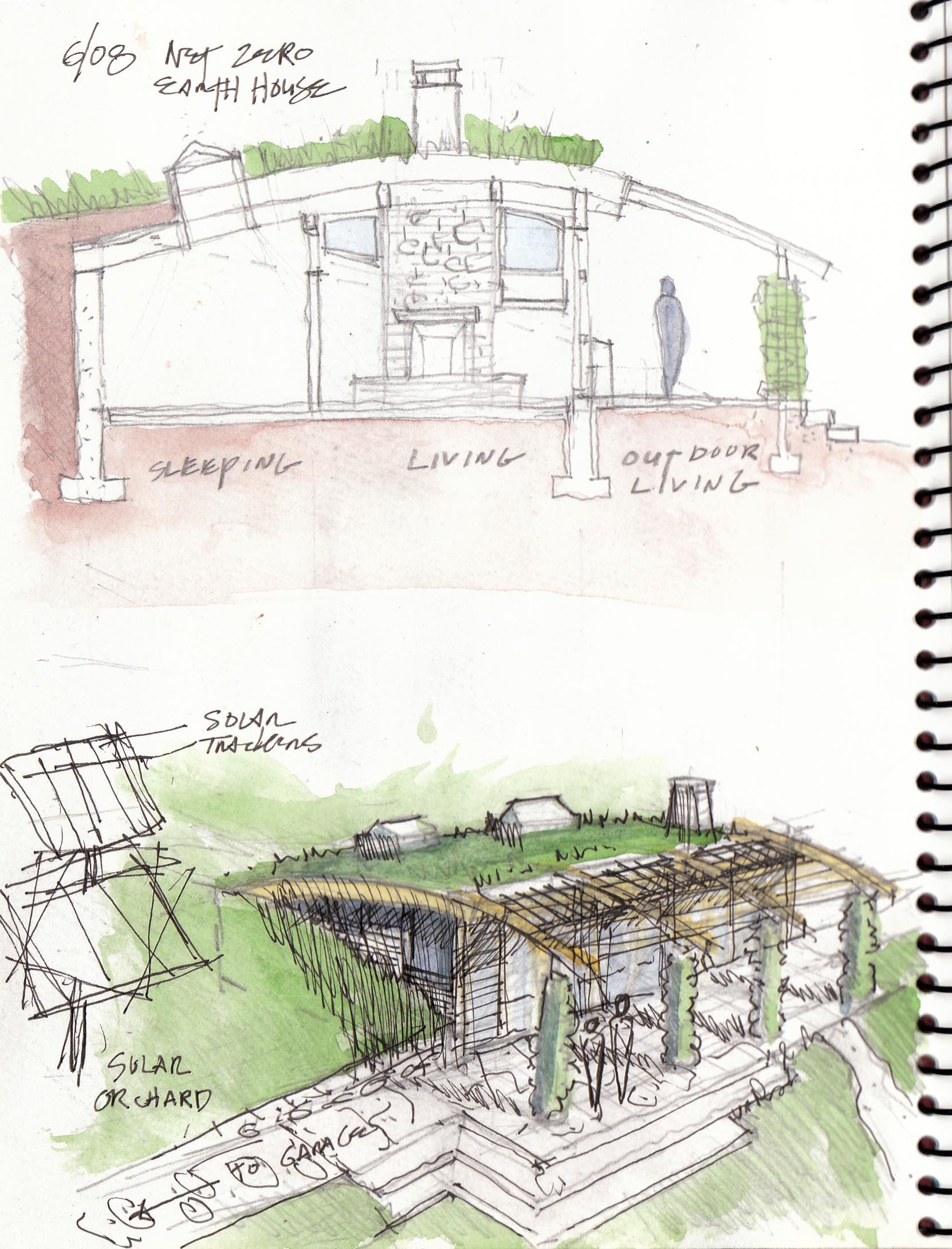
Net-zero earth sheltered home sketch, Stephen M. Frey, 2008
The layout: Open flow with private views
On an ideal south-facing sloping site, this residence is designed as a single-level sanctuary, making it surprisingly perfect for aging-in-place living.
The Great Room
The heart of the home is an open, interconnected kitchen, dining, and living space. Because the home is tucked into the hill, the acoustic quality is quiet and grounded.
Bedroom zoning
We organized the two to three bedrooms on the "wings" of the rectangular volume. This ensures that every private room captures a framed view of the outdoors, preventing the "cave-like" feeling often associated with underground homes. The middle zone would have a shared bathroom, closets and other support rooms to the great room living space..
A nearby garage and or barn space would supplement the home a short distance away. It could supply parking for vehicles, workshop and craft areas, accessory dwelling units, and long-term storage. To complete the integration with exterior design, a vegetable and flower garden would be nearby as well and other landscaping would be installed.
Pre-Closing Pre-Purchase Site Feasibility: Considering a similar custom Net-Zero build or prototype adaptation on land you're evaluating in Stowe, Woodstock, or the Upper or MadRiver Valleys? We offer flat-rate site due diligence consultations options to fit different budgets to assess solar performance, site and building planning, septic capacity, and budget alignment prior to closing.
How does the "Lifted Green Roof" work?
The defining feature of this concept is the roof geometry. Instead of a heavy lid, we sketched a lifted and separated curving green roof.
Daylighting: The lift creates a gap for high windows (clerestories) that pull light deep into the back of the room, illuminating the retaining wall.
Thermal Performance: The soil on the roof adds R-value (insulation) along with a drainage layer, then regular insulation in place below, and protects the roof membrane from UV damage and thermal shock, significantly extending the life of the materials.
Camouflage: From the uphill side, the home backs into a swelling berm. It blends seamlessly into the adjacent landscape, camouflaged by its ground-hugging profile. It only reveals itself as a piece of modern architecture from the downhill approach.
What makes up its Biomorphic Structural Systems?
The wooden glue-lam ribs of the home are akin to bones that spring from the earth! The residence transitions from the solidity and darkness found within the earth to the lightness of a forest canopy along the continuous south-facing porch and terrace area. An overhead wood timber frame arbor with solar control helps minimize summer glare while supplying a place for vines to grow. Timber frame posts and supplemental beams would abound in and out.
How does it achieve Net Zero Performance?
We imagine photovoltaic ground-mounted solar trackers in a nearby solar orchard a short walk away. They would tie into a nearby independent standalone timber frame structure that houses the whole house battery system and inverters. The building would bring power safely to the semi-underground home. The home could tie to the local power grid or we could design it so it is off-grid and fully energy-independent.
How do the sun, nature, and daylight connect?
The south-facing window wall area and short ends would connect to near and far views of the site and beyond. We would tailor the home and site design to frame near and far views with window and door openings. This approach also allows for safe exiting from bedrooms located on either end.
Dynamic top lighting from skylights and roof monitors activates interior spaces such as bathrooms, kitchens, and internal areas. Overhead, top daylighting from triple-insulated prismatic skylights lights these spaces during the day. At night, architectural LED lighting will highlight the underside of the curving structure. This will bring a day and night difference to the spaces within, activating them in unique ways at each time of day.
What is a high-performance building enclosure?
The building enclosure would be super-insulated, suitable for the local climate and building traditions and regional preferences. It would follow at a minimum (R5/R15/R20/R45/R80) for windows, below slabs, walls in below grade conditions, walls above grade, and the ceiling as recommended by Joe Lstiburek, Ph.D., P. Eng. of Building Science Corporation. Windows of this home would have triple-insulated high-performance glazing with low-e argon-filled units with thermal spacers set within fiberglass clad and interior wood frames. Operable awning and casement windows would act in tandem with energy efficient ceiling-mounted fans to circulate healthy fresh air in warmer times. There are many excellent American-made and European-made window brands to choose from.
We envision the doors as made from fiberglass frames with thermally broken edges. The nature near Green roof could be extensive or intensive depending on the client’s desires and structural capabilities, cost, care preferences for the plantings, etc. It would help with stormwater management capturing and filtering rainfall. Construction would follow aggressive air-sealing standards to further reduce energy loads by minimizing energy loss through cracks, corners, and joints.
what are good siding options?
The exterior rain screen siding could be low-carbon thermally modified wood, cement-plank, local board and batten cedar, or metal siding such as metal panels, corrugated metal, or 12-inch ribbed siding. Depending on the preferences of the client, we could mix and match siding options that met their preference for durability and ongoing maintenance over the years..
how to bring the interior to life?
A radiant polished concrete slab with decorative insets would supply heating. Air to air wall mounted heat pumps would supply cooling and supplemental heating as needed, A very small super-efficient low-btu outdoor venter wood stove could be included more for ceremonial purposes.
We would choose simple and restrained interior finishes, using local milled rough-sawn lumber or, if a client wants a more modern interior design, we will use finished hardwood standing and running trim with a contemporary design. Hand plastering or drywall would complement the interior. The doors and kitchen would have simply rubbed bronze hardware and pulls. Paints and coatings would be of durable no or low-volatile organic compounds. (VOC) for good indoor air-quality.

Interior sketch concept.
Appliances would be high-performance energy star models to reduce energy use. We recommend all-electric, but it is important to have backup generators onsite in case of power failures and depletion of any home batteries. With Vermont’s increasingly warmer winters with wet snows damaging power lines, it pays to be prepared for anything and to keep climate-resiliency in mind when planning and constructing this home.
How about considering layered lighting?
High-performance LED lighting would light the interior and exterior of this house and its site with a layered-lighting-design strategy. We would specify a mix of dimmable low-voltage architectural lighting emphasizing the ceiling and exposed Glue-lam and timber-frame structure, as well as downlights, wall-washers decorative pendant fixtures, and sconces. A thoroughly thought-out layered-lighting-design like this would amplify the enjoyment of this home for years to come.
Where would we find local materials?
We envision focused areas that would have locally sourced stone areas using Vermont slate, granite, or marble. One could also specify Vermont Soapstone counters for the kitchen and bathroom vanity counters. Another area to plan is to use solar color shades and blinds from nearby manufacturers on the south and west-facing windows to control overheating and glare. We advocate the use of local milled lumber as well.
Want to learn more or take next steps on your own custom home design?
In our design for this unbuilt Vermont net-zero home, we seek to capture nature’s beauty with our sustainable and artful living mindset. Yes, it is just a sketch but it has informed the heart and soul of our work for years. In some ways, we feel like we have been chasing this notion for our professional life. From the curved green roof to renewable energy, and interior and exterior site connections, every detail supports living in harmony with the environment. If you’re intrigued, let’s discuss adapting this design or aspects of it to create your dream home.
Let’s design and build a place and space that reflects your style and values while honoring Vermont’s landscapes and sustainable living ethos. Contact us today to begin this journey!
Want to see more examples of built, under-construction, in-design, or prototype residential projects? Click on the link below to return to our Residential Portfolio to see more. We do call your attention to modern-spirited home designs such as Wing House, ZigZag House 2, InsideOut Home, FieldHouse, Modern Farmhouse in Northern Vermont, and more.
Arocordis Design, a custom home architect and planner, has served Vermont families since 2010. We provide licensed architectural services throughout Central Vermont, including Waterbury, Stowe, Montpelier, Calais and beyond. We also serve the Burke, St. Johnsbury, White River Junction, Tunbridge, and the Woodstock regions. We specialize in modern-inspired home design that connects to Vermont’s past while providing a creative vision for the future.